Stories and poems

"The metaphoric image of 'orphan lines' is a contrivance of the detached onlooker to whom the verbal art of continuous correspondences remains aesthetically alien. Orphan lines in poetry of pervasive parallels are a contradiction in terms, since whatever the status of a line, all its structure and functions are indissolubly interlaced with the near and distant verbal environment, and the task of linguistic analysis is to disclose the levels of this coaction. When seen from the inside of the parallelistic system, the supposed orphanhood, like any other componential status, turns into a network of multifarious compelling affinities.'
Roman JAKOBSON, "Grammatical Parallelism and its Russian Facet", Language, 42/2, 1966, pp. 399-429, p. 428-429

Showing posts with label poetry. Show all posts

Wednesday, December 14, 2011

A Certain Kind of Eden

Mid-december. I had started  a post about teaching children, which I do a lot. Maybe I will keep doing that when I am done. Progress has been slow, and the winter has come accompanied with its usual difficulties: I want to go really slow. This has not been helped by the fact that I haven't had a vacation in a while, and I need one. I am taking one, and I hope to come back to writing with renewed vigor, though for now, I can't stand it. Why did I decide to write a dissertation? I feel like it was a purely masochistic idea, fueled by a need to prove myself to someone, but I don't remember who. All I want to do is knit. I need a vacation, did I already say that?

I am enjoying reading a Hardy Boys mystery with one ten year old. He really likes it, though he doesn't understand everything and I have to explain to him the finer references to American history. The Hardy Boys were from New England, and that is where I am going in a few days. Maybe there will be some mystery to solve, involving my manuscript perhaps, an old library in New York, a stolen book. I think I would like to write children's fiction. It would be difficult to come up with all those details that keep the little reader reading, and I think I would want to get rid of stock figures like the fat friend who is trying to lose weight, the single and overly maternal aunt, the "drifter" (I had to explain that that was an old fashioned term for a homeless person). I like explaining the nineteen sixties vocabulary to my student. Today he asked me, "did they have electric boats then?" I answered him, "yes, I think so". I'd have to get better at writing dialogue. I am not even sure how to punctuate it. In the Hardy Boys series, I like the use of italics. Mostly it announces danger.

I shared the following poem with my poetry group with relative success. It's an odd poem, an old poem, but it describes pretty well how I feel during these darker days. My friends and readers were helpful about what to get rid of, how to rename it, what worked and what didn't. Mostly it did work, so I'm sharing it here too:

Wading the depth that was our eye to eye

I went to the market but there wasn't a market
I walked by the ocean but there wasn't a shore
I watched the sun rise but there wasn't a mountain
I saw the sun set from behind a closed door.

If walking and searching and seeing are chances
To find and not find, to lose and combine,
I'd rather be wading this edgeness of nothing
Then sitting at home dreaming twine and untwine.

And if tomorrow you can find me laughing
Don't take and don't mend, just circle the time
With your finger and gently do place me upon it
And turn me and twist me and find my right rhyme.

I went to the market but there wasn't a market
I woke up to darkness on a sandless shore
I climbed to the top but forgot that the mountain
Was downward bent feeling my heart's hidden core.

One reader said it was a ballad, a ballad to sing perhaps, though I am not sure what it's about. I feels like it comes from somewhere deep, somewhere I don't really know about, the place, perhaps where the poetry comes from, elsewhere. One of my readers, author of a captivating book, Little Venus, which I highly recommend, mentioned that I might like the poet Kay Ryan, recent poet laureate, because of her use of rhyme. And I do. I leave her with you, in this season, when, perhaps, we would all like to go back. 

A Certain Kind of Eden

It seems like you could, but
you can’t go back and pull
the roots and runners and replant.
It’s all too deep for that.
You’ve overprized intention,
have mistaken any bent you’re given
for control. You thought you chose
the bean and chose the soil.
You even thought you abandoned
one or two gardens. But those things
keep growing where we put them—
if we put them at all.
A certain kind of Eden holds us thrall.
Even the one vine that tendrils out alone
in time turns on its own impulse,
twisting back down its upward course
a strong and then a stronger rope,
the greenest saddest strongest
kind of hope.

Maybe that is what I need, a certain kind of green, a certain kind of hope.

Thursday, September 29, 2011

Muse

Monument in Cordoba to Ibn Zaydûn and Princess Wallada
September has slipped away in a sunny haze, end of summer, busyness and bees. Some goals were achieved. I have found some work to keep me writing through the end of the year, now I just have to get back to the writing. Interestingly enough, I'm helping various children write, which allows me to tap into my own desire to write. I wonder at that easy creativity children have, which goes along, I think, with a refreshing and spontaneous naivety. Afterwards, leaving the tutoring session on my bike, I let myself laugh.

I went to a poetry group, which was also refreshing, and gave some air to my poetic thoughts. It made me want to write more. Words and words and words, en boucle; it helps, as though I could put myself in a room of words and wrap myself up tightly there, and stay, and stare, but not alone. Exchange around writing is a necessity, and words engender words, in the presence of others, please. But how does that suit our idea of authorial invention and the private property of the written word? I think it's poppy-cock, and that my poetry is never mine. That's not to say though that I wouldn't want to call what I write here mine, because it is. There's a conundrum: how creativity can be so completely from somewhere else yet pass through this body, at this time.When writing, or singing, there is like a breath which comes from behind and passes through the exact center of the head, then out of the mouth, or the hand. One knows not from whence it comes. Other poets have called it inspiration, or personified it in the figure of the muse.

I wrote a poem once on being my own muse: 

On being my own muse

I would no longer need the body of another to feed my words if I could write like wrapping myself in seamless white linen, having woven the fabric, etching words with thread, tying the knots that keep me in.

Ultimately, I think this poem  is about a desire for self-sufficiency, not separateness. The idea is that the words keep me in, define me, and that their source is within, they don't come from the outside, the result of some exterior passion or pain. I think it's about the wish for the source of poetry to be interior joy, even though the image is quite morbid. In this poem I also see a funeral shroud. I see the death of the poet. 

A medieval writer and princess from Cordoba named Wallada Bin Al Mustafki had her poems embroidered on her robes. She wore them in the street. She also had many lovers and her passions inspired her writing. This is apparently what those embroidered verses said:

For the sake of Allah!  I deserve nothing less than glory 
I hold my head high and go my way
I will give my cheek to my lover
and my kisses to anyone I choose. 

I think she was her own muse.

Thursday, August 18, 2011

Insects

This morning there was a grasshopper on my curtain. I was flattered he mistook my apartment for the out of doors; maybe it was all the plants or the rabbits. I tried to put him outside, but he jumped very high up, and seemed to fall behind the dresser. I couldn't find him, but I left the window open so he could find his way out again.

Summer is a time for bugs. Perhaps because I am alone a lot, I enjoy speaking to them in my mind. I think of Dahl's James and the Giant Peach, and wonder what it would be like to have a conversation with one. Here is a poem I wrote for a moth: 

Insects

Wasps, ticks, spiders,
bees, houseflies,
gather round,
now is your time.

Settle in,
make it brown
or black
with the sounds of your wings.

You are drawn to my heart,
my breath like light
but soon again, move off,
say a prayer for me.

Leave me silent,
moths in the night,
sit tight on white
porchboard.

Fly off now,
sticky residue
of black burnt
feet, stubble, wing.

Sleep now,
tunnel,
buzz,
zs.

Reflections on insects hide my desire for focus and motivation. I like to think the grasshopper will bring me luck and help me finish the chapter I am working on, but only I can summon that. I don't always like what I read. Can I make true statements? True for myself, or being true to myself, that is what writing is. When I leave myself, it is sleep, or daydreaming, the lives of all the infinitely small beings around me. Perhaps I could draw them: all that infinity makes spacious unity. 

Monday, August 8, 2011

Carpe Diem

As an obvious rejoinder to my reflections on death, I wanted to post a poem about seizing the day; I couldn't find one of my own. Then I realized, all my poems are the result moments that I seized, a kind of verbal carpe diem, so perhaps they never need to address the issue. Maybe that is poetry, seizing the day, in words. 

Friday, August 5, 2011

Death

I said I would post more on Death today, since in Pasternak's poem August the poet sees his own death; his writing at the end, as his own death approaches, as his friends come to him, as he dies. Sometimes I feel like we ignore death so much it becomes like the vacant center, the unsaid, around which everything turns. I don't think it's such a big deal, really; I like the rhyme, in July, maybe I'll die which came out in song I was writing the other day. Since it's August now, I can share it. 


I recently saw the movie "The Sea Inside" (Mar adentro, which, incidentally, was also directed by Alejandro Amenábar, director of the movie on Hypatia I wrote about the other day, Agora), which I think is an apt metaphor for death, a going in instead of a going away. Death is a mystery, but there are other mysteries. People die and we keep their pictures, or make movies about them, idolize them, use them in some way. We don't want them to die, but they do. I would have more to say on memories, memory, and how it shapes the mind, and shapes who you are, long after some people only wander through your dreams. But then how many of us are actually awake today?


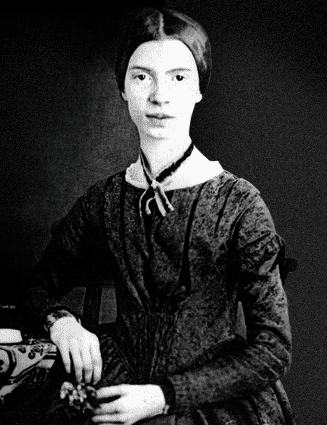
Then there is writing, which dresses the corpse and keeps it talking long after the dust has been blown away. The holy grail of the written word for many authors I think, Pasternak's angel: Immortality. Which makes me think of an Emily Dickinson poem. I'll see if I can find it.

Because I Could Not Stop For Death
Because I could not stop for Death,
He kindly stopped for me;
The carriage held but just ourselves
And Immortality.

We slowly drove, he knew no haste,
And I had put away
My labor, and my leisure too,
For his civility.

We passed the school where children played,
Their lessons scarcely done;
We passed the fields of gazing grain,
We passed the setting sun.

We paused before a house that seemed
A swelling of the ground;
The roof was scarcely visible.
The cornice but a mound.

Since then 'tis centuries but each
Feels shorter than the day
I first surmised the horses' heads
Were toward eternity.


That was easy. I love the false subtlety of the rhymes in this poem. I love the way the word Immortality is placed.
Well, people die and we do miss them, still:

Why do we focus on death
when it is not the road?
A transfer station, 
a place to switch over,
circle back. 

Somewhere in you is
a free and seeking bird,
the white of its neck,
your body beautiful to it,
I need not hold.

This time could be long
or short, 
is on our side, what's next?

It doesn't matter still,
our small moments here
eternity were more than
bright lights intermittent.

We have smiled at each other
We have watched the sun rise.

I think the second to last stanza of this poem is nice in the same way the Emily Dickinson poem is nice, but I'm not sure about the rest of it. This stanza also reminds me that I read e.e. cummings a lot as a teenager. What do you think? Will it keep me alive after I'm dead? I wonder. Would a word or two suffice? Thousands of poems in drawers. In any case, thank you, Emily.

Friday, July 29, 2011

On the Sublime

I'm still wandering through late antiquity, led by Allegory, though I should be writing about 19th century philology. The hows and whys of textual preservation are fascinating to me, how is it we know what we know about such distant minds.


I read about the brilliant philosopher Hypatia, who was killed in Alexandria, and someone else who lost his head for thinking. I dreamed of the library there... A movie was made about her life, in 2009, Agora, which means, in Greek, a place of assembly, and in Portuguese, now. 

On the Sublime

To have been a scholar
in late antiquity
when a thinker got his head cut off
for being an advisor at the wrong time.

There was a woman
murdered in Alexandria,
before the library burned,
when we knew the origin of all things.

She taught philosophy, geometry,
Plotinus hated Longinus
who didn't write, finally,
On the Sublime.

The monk who read it cared too much.
Maybe he too wanted to be
that reader who would pass it on
to posterity through troubled times.

Today we hardly think
about the universe.
We take its picture.
It blinds us. We are blind.

Now, I should get back to work.

Wednesday, July 27, 2011

Le vers orphelin

Writing engenders writing, or so it seems.
I've been seriously writing my dissertation for a few weeks now, watching one page a day become three pages a day, then watching my productivity fall back down again. It seems to come in waves. I've even written a poem or two, in between pages, as a break, or as commentary. I thought of sharing them. Then I realized that I had many to share. So I'm starting here, with one, the first one:

Le vers orphelin

An orphaned line
sits all alone
without a rhyme,
he has no home.

No coupledom,
no sense complete,
no rhythmic fun,
no bowing feet.

An orphaned line
sits all alone
between two more;
one ends, begins,

but him begun,
that thought a rhyme,
could never be
a part of one.

An orphaned line:
A scribe forgot
to put its pair
there in its spot;

no space, no room
for an addition,
just sad, alone,
full of contrition.

On a more serious note, here is what Roman Jakobson has to say about orphaned lines, and I am rather partial to his opinion:

"The metaphoric image of 'orphan lines' is a contrivance of the detached onlooker to whom the verbal art of continuous correspondences remains aesthetically alien. Orphan lines in poetry of pervasive parallels are a contradiction in terms, since whatever the status of a line, all its structure and functions are indissolubly interlaced with the near and distant verbal environment, and the task of linguistic analysis is to disclose the levels of this coaction. When seen from the inside of the parallelistic system, the supposed orphanhood, like any other componential status, turns into a network of multifarious compelling affinities." 

From: "Grammatical Parallelism and its Russian Facet," Selected Writings : Poetry of Grammar and Grammar of Poetry, p. 135)

An orphaned line, there is no such thing!
Here's to growing a "network of multifarious compelling affinities."