Stories and poems

"The metaphoric image of 'orphan lines' is a contrivance of the detached onlooker to whom the verbal art of continuous correspondences remains aesthetically alien. Orphan lines in poetry of pervasive parallels are a contradiction in terms, since whatever the status of a line, all its structure and functions are indissolubly interlaced with the near and distant verbal environment, and the task of linguistic analysis is to disclose the levels of this coaction. When seen from the inside of the parallelistic system, the supposed orphanhood, like any other componential status, turns into a network of multifarious compelling affinities.'
Roman JAKOBSON, "Grammatical Parallelism and its Russian Facet", Language, 42/2, 1966, pp. 399-429, p. 428-429

Monday, April 30, 2018

Calling Down the Moon

The Moon is Me

I'm in the moon,
each knee,
each buttock too,
the moon,
each elbow,
each breast,
the moon.
The moon is me.
My head, the moon,
a little moon.
The moon is big
and bright in me.
The moon is full
in me, the moon
fills out my curves,
is hip, is round.
The moon in me,
it enters me
and fills in me
what isn't found.
The moon, it calls,
it makes me
round, it takes me
near, it enters
here, the moon
in me, is round,
is full in me
the moon is.

I've started a new blog with more philosophical musings and plant spirit offerings for your healing journey. Read more there! https://enosburghessences.wordpress.com/

Sunday, November 26, 2017

How Daphne Became a Tree


How Daphne Became a Tree

Running from the god of sun:
It must have been like
this grey light
of early spring,
a changing time
before the flow’s begun,
bitter ends that start, 
the tips of buds on branches,
but, batter back
my leafy bower
and savor February, March,
unsure,
not yet,
until the rain
to wash,
transforms again,
becomes.

Tuesday, November 14, 2017

Gold Can Stay


The Connecticut River in fall from the train
I’ve been thinking a lot about my writing and it’s connection to place, and about writing in general and how it often springs from our experience of a place, how the land fuels writing in a mysterious way. Does the poet give voice to the land, a kind of land ventriloquist? Certainly the poet often speaks for the land, channels spirit of land, learns to hear the songs the seep up from the earth like water in a boggy place. I put my foot down and the words come up around and in between my toes. On the land, the words come. I’ve been writing from the land.

A year ago I returned to live on the land I’ve known the longest and most deeply on this my current trip to Earth. I wasn’t born there but I’ve returned consistently for different periods of time since I was born and I feel attached to it in a way I imagine people must feel who have stayed on the piece of land on which they were born. I know the rocks and the trees; I know the lay of the land. I recognize the curve in the road. It’s like the face of a friend. It’s in Northern Vermont, and since I’ve been here I’ve been thinking of the writers who write and wrote in this state. It’s a good place to write. Robert Frost’s poems touch me deeply when I am here; reading him here makes me feel the meaning of his poems more keenly. This fall a poem of his kept running through my mind as I admired the leaves turning: Nothing Gold Can Stay. It’s a poem he wrote for spring, which I’ve always loved because it comes so very close to describing that first green I love so much that comes before the leaves have opened, just after the red buds of the maple trees have begun to blush. Riding a train down the Connecticut River this fall I read it again.

Nature's first green is gold
Her hardest hue to hold.
Her early leaf's a flower;
But only so an hour.
Then leaf subsides to leaf.
So Eden sank to grief,
So dawn goes down to day.
Nothing gold can stay.

It’s a fine poem because the lines are short and the rhythm and rhyme are regular; it reads like an incantation. It speaks to the concise innocence of spring, and it also calls on the melancholy feeling one has when one remembers the brevity of sweetness, how blossoms and kisses are fleeting and don’t last and how one would like to hang on to them. Both the meaning of words and the form of the poem speak all this to me, which I think makes it strong. I think the land spoke this poem to him. Pondering the fall, I responded with this. I tried to follow his form as I could and also contrast his brevity with the permanence I feel sometimes on the land when I feel its cycles. I wanted to say, The Gold, It Stays:

The peak is past and yet the gold,
Intemporal sap at the heart of things,
A promise in scarlet of cold to come,
Reminds me of what stays.
This season of dying calls the green again,
This ending beginning of diamond days
Reflecting casts and beams of light,
The gold, it stays.

Here I’m not sure if I’m writing from the land. I’m editing it at a distance from the train ride inspiration of my scribbles and channeled poetic intuition. I’ve made my lines fit his, more or less, but missed the conciseness that is so lovely in his. I’m writing in another place and time. I’m responding to the poet, who was a man. I often think of how I’m always conscious of writing and reading as a woman. It doesn’t go away. Also here, we have the reminder of Eden, and so of Eve and her fall, and I want to push all that away. The leaves to me do not recall this fall from grace. And I see I've put a “me” into the poem, which he didn’t. Sometimes I just want to say and do the opposite of all the men offered to me as models, like a child who wants to protest all this dominion. I want a way to say what I want in my own way. But often I still say to myself, Nothing gold can stay. Maybe I wanted to show how one statement often holds its opposite, which is the irony of the poem as well. His poem stays with me, despite the impermanence it describes, like its engraved on my heart. The gold is too, the gold permanence of my forest home. And I like that, that Nature’s last green is gold too. The trees told me that.

Tuesday, May 30, 2017

To Be A Flower

Have you ever been a flower?

Do you know what it is like
to stand, to root, to grow,
to shoot up filled with light?
To bend slowly and smoothly.

My bones have dissolved back
into the earth, as calcite.
I am golden and round at the top.
My heart is pulsing and green.
Where my leaves run, my blood is white.

Have you ever been a flower?
The flower asked me and gave me this gift
of sight, no, to feel, no, to be a flower.
Here, he said, be like me, and I will
show you how your body too can
be with every root, in every tree.
From seed to growth and back to seed
but rapidly, to be sown on every continent,
endlessly, to be unique, complete,
yet various and varied,
rooted and movable,
tall yet going down
so deep, to the gold beneath the earth
resplendent in me. 

Monday, April 24, 2017

A Poem for Peepers

Virginia Herpetological Society
A Chorus of Frogs

Peepers, make the sound of the
universe, small and round
not big and black,
light, inside the night.
Peepers, their voices
outlast their echo, calls,
resounds. Peepers
make that small sound
in the cold April dark
by a pond, the reeds
just reaching, the lillies
still asleep, the daffodils
would open inside.
Peepers, make that sound
of the universe, the cosmos
in an acre of land.
Peepers, a friend to space,
at midnight, in the dark,
you make my heart
open wide like the universe.

Sunday, April 23, 2017

A Story for Spring


The Ice Princess and the Sun God

Once upon a time, in a dark forest, there lived an Ice Princess. She had lived alone there for so long that she didn’t remember who she was or where she had come from. All she knew was that she loved the trees and the darkness and the shadows and that they kept her alive. She loved the snow on the moss, the stones in the hard dirt, the crunch of dead leaves and the branches that creaked and fell to the ground. She couldn’t remember spring. It had been dark and cold for a long time. She had forgotten about the cycles.
             One morning she woke up in her stone castle and wanted to go out for a walk in the gloom and admire the imprints of her boots in the snow alongside the tracks of the creatures that lived with her in the cold forest, but when she opened the door, she almost cried out in surprise. Everything was sparkling! The icicles on the trees looked like silver shafts and the snow crystals were glinting and dancing in some strange new light – the Sun! She saw a beautiful golden man coming towards ther through the trees, bringing the light as he came, making the ice start to drip and the plants look alive again. She was amazed. The man was tall with golden hair and green eyes, all dressed in green with a thick, brown wool cloak wrapped around his shoulders.
As he approached, she thought he was coming towards her to greet her, and she wanted to invite him in, ask him to take off his cloak, and get to know him. But when he drew close to the castle he turned abruptly away and started walking around the building as if he hadn’t seen her. She ran after him, confused. It had been so long since she had found someone to talk to and she worried that her voice might have frozen as well. As she was running after him, she realized that just as he couldn’t see her, he couldn’t hear her either. She reached out to touch him, but as she did so she felt her body start to melt as well, as though to touch him was to die. She wasn’t ready yet so she let him go.
After that, every day for a month, the Sun God returned and every morning the Ice Princess watched him from the doorway of her castle, making his careful way through the trees and branches, slowly bringing light to everything and making the Earth green again. Every night the Ice Princess went back to her icy bed and dreamt of being able to be a part of spring, but she was scared of what she had felt when she touched him, and of the change it presaged.
One morning, as she watched, the Ice Princess noticed that the Sun God was not alone. He was with a beautiful brown skinned girl who held his hand and laughed and kissed him as they walked. She lay down on the warming ground and he joined her, bringing new life to the Earth where they lay. As she watched, she silently screamed, for she recognized her intense longing for him and yet she knew that they would never lie like that together because she was not made of the Earth. His warmth would be too much for her and she would disappear. Yet afterwards, as she watched them leave, she suddently felt ready. She prepared herself, knowing that the next time, if he came alone, she would reach out to him, at the risk of her own unknown transformation. Even though she knew she would melt, she would at least get to partake a little of his light.
The next day he came alone. He knew it would be the last time that he would have to take care of this portion of forest for the snow was almost gone. Only a few patches remained in the shadow of the rocks. The birds were singing and the trees were humming with the birth of new leaves unfurling. As she saw him make his rounds of the forest, going in and out of the trees, she felt ready. She saw him come and ran to him, throwing her slender white arms around him. As she did, she began to stream down and around his body, creating little rivulets and forming a small stream at his feet. The God felt blessed by this sudden, sweet shower and he blessed in turn the river as he passed, watching it run over stones, twist and turn as it found its path, gurgling through the forest.
It was then that the spirit of the Ice Princess understood and was glad to have embraced her change, for though she missed the cold solidity of her body, she loved the flowing feeling of being a part of everything and of bringing another necessary element to the life around her. In her own way, she also brought nourishment to the forest, and like the Sun God, she was integral to spring. She infused the land with creativity and growth. The Earth held her as the Sun sparkled on her burbling and babbling, shining through the branches of the trees and the leaves. She remembered the cycles and knew that the time would come when she would once again find her icy home.

Monday, January 2, 2017

Turning in

Solstice and the beginning of the roman calendar year is a dark time meant for turning inwards. We all enjoy this to differing extents. This year I've been able to do it at home, near the fire, in the forest, on a dirt road, in a closed room, in silence, with support and regular warm meals. It hasn't always been so and my winter grieving this year has been more bearable than most.

I didn't post anything at all in 2016. I think the whole year was, in some ways, a turning inwards, but also a turning outwards in ways that didn't involve thinking about lines of words to present to a public. I was seeing and experiencing things more urgently and directly. I don't think I was alone in this. 

I do want to share more writing this year. I have lots to say that I learned from the trees, they need more human language users these days to speak for them, and I need to practice this form of expression, which sometimes feels so strange and difficult. It's crucial for our survival that we realize how connected we are to the land we live on, to other creatures, and to each other. I think our words, though often divisive, can help with this. 

Everything is happening inside, which is also what is happening outside. I'm becoming more and more familiar with my cycles which are also the outer cycles I am a part of. We've put new names on things, but at this time there is still a baby born to a goddess which is a new light bearing gifts. There are still many languages to learn that aren't our own, and that place that is always mysterious, that we can always turn to for contemplation and for ressources, to re-source (se ressourcer the French say). It's infinite inspiration. 

Dark Moon

This is my dark moon, and yours too, a chance 
to learn all you ever wanted
from the mountains of your heart
and the ridges of your soul.

You can be dark too,
and Time doesn’t know
the straight path down to your toes.

It picks its way among the bones,
whitewashed in moonlight
from the month before.

A month which dried them out
as, staring at the sky,
desert eyes and bright,
they shattered in their last attempt
to fix the progress of the mind.

Stay in this new place with me,
this sacred space, made of stardust,
and wait for the dawn
that will come on the wings
of locusts.

Sit and stir your pot for now
as we wait for the sun
that doesn’t come.

We recognize our devotion
to the present path,
our faith, even when
no light has ever shone
on these dark shores.

Monday, November 30, 2015

Finishing the document

So about a month and a half ago I turned in my dissertation.

I realized today that, as I have been writing that book for so long, another one was being written, in the shadows, so to speak, and that I also have ten years of poems, at least, written on paper bags, the backs of envelopes, the bits and scraps of other projects, in journals, each one unfinished. There are in fact so many that I could beat my record and certainly post more than just a few year on here while I think of what to do with them.

And now I have the head space to do so.

And the Moon is in Leo, which makes one, usually so private, with my Black Moon Lilith in the eighth house, audacious, wanting to put oneself out there, here we go. For, in spite of the lover who thought himself clever to call me so, I am no Emily Dickinson. I will not keep all these poems in drawers. Every few days or so, I will pick one out of the piles on my desk, and if I like it I will post it and I will throw away the ones I don't. And who cares if there isn't any reason anymore to write poetry and if I'm all out of sync with the times.

They were meant to be read by someone, by you, though I didn't always think so, though it isn't always true.

This one I wrote during the last few weeks of writing. It's called 

Finishing the document 

My small heart a rabbit
I leap and thump
I don't know why
a basket that didn't burn
a relic untouched
a body that rose from the dead
a dream she lost an eye
they retreated to their rooms.

I've loved before now,
I have, what hurt
to let go of, to
love again, what prayer,
what bell,
I rang the one
in my heart
it was in tune with yours.

What's inside
so strong one moment
so fleeting then. 

I think, perhaps, it captures some of the frenzy of that last month of writing, of what I was reading and feeling, of what it's like to finish a long project.

Friday, April 10, 2015

The Green Bench

It is spring, so I must write this thing, and it must go out, like so many other things.

Sometimes all there is to do is to make space in your body for it to feel a thing, feelings which must come, and then go. We are usually happier with the letting go.

I had a dream I was sitting with my love on a stone moss-covered bench.

Mostly I sit inside, these days, looking out. There is a tree growing out of a hole in the stone wall I can see from my basement library window spot. There are people outside on benches I can see from the upstairs window spot near the books on red attic vases. I wrote this poem the other day while observing two of them.

The green green grass

Two lovers on a bench
were men supporting 
each other were not
fearful in the spring
the new leaves like 
perfect capes just opening
another green, bright
against the grey
were leaning against
each other supporting
this spring were you
and I the same like
lovers we would sit.
Here, stay, I'd say.
You're far away another
green has come to sprout
each bud-miracle a gift
of life, we're the same,
I'd say. 

With my dissertation, I'm doing a strange kind of writing. I have old paragraphs, pages, no structure to rework, but my own mental work, eight years of it or so, to add, as a layer, to the already existing text. It is interesting work, sometimes frustrating, but sometimes strangely satisfying. I wonder if my readers will be able to perceive the layers. 

Maybe that is why this poem is rather strange. I don't want syntax, I don't even want form, I want a few commas, and some images, some green. These days that's all I really want, some green.


Saturday, February 21, 2015

A Tribute to the God of Thought

A Tribute to the God of Thought

Please, look at both sides of things.
Do not fear your own inhibitions.

Take out your mind one more time
and dissect it, the ripples are there for a reason.

Don't balk at your own contradictions.
Don't strive for a dead unity that isn't one,
similarity that is not fecund,
the grey matter of impossibility.

Let your process grow beyond recognition.
It will find a way.

Take it upon yourself to keep growing,
despite this dead way,
make a tribute to the God of thought.


I wrote this poem the day I left Geneva in January for travels up north. I am back now, and the the new lunar year has begun, and I need to get back to work. I'm wanting and expecting things to be different. A change will come. 

I'm unsure of where this poem came from. Maybe I just needed a break in thinking. Maybe I was tired of the God of thought.

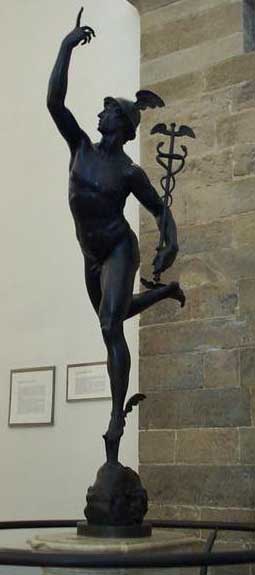
Who is the God of thought? My first thought was that it was Mercury, or Hermes, and it is. The internet first points me to Odin, who has two black crows who tell him things (two black crows tell me things too these days - I'm not sure what). Then someone in a comment on a strange page (one wonders where they all came from) said it was Hades, and thanked me for reading him, but I'm not sure about that, though it is in my poem, the dead way. Then there is Thoth, Egyptian God I don't know very much about but who surely is at the root of things, the root of thought. According to this website, he was the God of the moon. A scribe, he invented writing.

In any case, the God of thought is good at duality. Which makes me think, there is no good reason to think. We are better off without thinking, or, joy is a function of thoughtlessness, though reading messages from the world is a full time job. And Mercury married, guess who, Philology, and that brings me back to the reading and writing I have to get back to.


Saturday, February 7, 2015

Ten of Wands

I'm going with the idea of tarot card inspired poems, and since I drew this card today, I'm posting this old poem about the ten of wands.

Ten of Wands

Gathering, gathering reeds to myself.
The devil lies at best,
to transform my passion is the test,
to meet at both ends,
to catch and survive
these deep desires
that spring from long lost faults
in earth and founts of fire,
here, back to the ground, cool down.

Form, gathering reeds to myself,
make a balance between us,
your need and mine,
healing, breaking or broken, fine.
I'm working, I'm thinking,
I'm pouring my love into cups,
back out, then in,
sorting and shifting,
gathering reeds to myself.


I realize I often carry burdens that are not my own.

Putting the burden down can be trying, or at least difficult, though this seems strange. It ought to be easy to put something heavy down, but sometimes it isn't. Sometimes I want to lug this thing around, this heavy thing that isn't mine.

If I open my arms, the reeds fall, and I am empty handed again. Everything seems quite simple and I can use my hands to do the important things in my life that need doing. 

Thursday, December 18, 2014

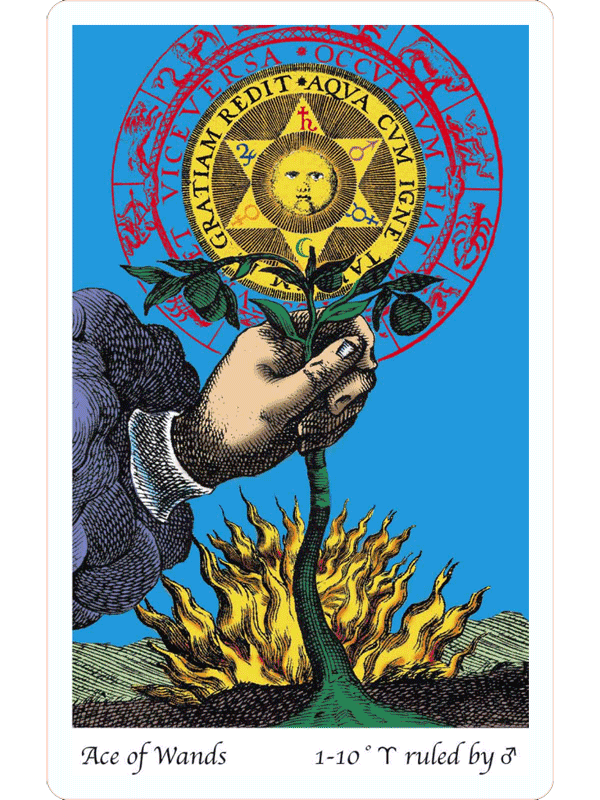
Ace of Wands

Oh yeah, I write poems. I haven't in a long time, or I do and then I put them away and I don't think about them. But today a tarot card inspired me and this came out and I shared it with a friend and then I thought, it wants to go out wider, so I'll send it on its way.

I'm back again with Philology, describing the 12th century Quedlinburg tapestry. This somehow takes a long time. Maybe because I haven't seen it in a long time, maybe because it is hard to understand how to understand these figures from another time. Still, I love them. You can look at them. 

I'm about seven pages from really finishing this chapter I've been writing for so long, but I feel stuck and haven't made much progress for a few days. I have been correcting too, and this makes every word feel weighty, as though you don't want to let it get away and it must be just right and it can't be.

Anyways, I got the reversed ace of wands, thinking about a situation I am unsure about. I really like my favorite deck's image, Golden Tarot, an angel with a flower and a wand, and a book at her knees, and the fire behind.

I looked at this one when I wrote the poem, from the Holy Light deck, but the other one was there too, in my mind, since I've looked at it so much :

There is the flame and the branches and the leaves, a good message for the winter solstice.

Ace of Wands

I’m stretching myself up,  
I’m getting taller,
I’m alone, but I have branches
leaves, I’m fueling energy
for growth, I like the way
I feel, I want to continue
this journey, I want to heal.

Reversed, I’m not reaching out,
I’m looking in. Inside
is the answer I am looking for,
though I doubt myself sometimes.
Though I am silent, I am not
ineffectual. I take action through
no action, I feed objectless desire.

There is a spark inside me that is ready
to burst into flames. Watch out or else
you might get burned. It’s all new and
waiting. This fury will become
something good, with time, this rod,
stick, wand, will grow in two directions,
both up and down, so hold on.  

May all of your darkest nights be bright!

Thursday, March 13, 2014

New Pathways of the Mind

 In Russian it is called rasputitsa...http://www.thegardenerseden.com/?p=8453
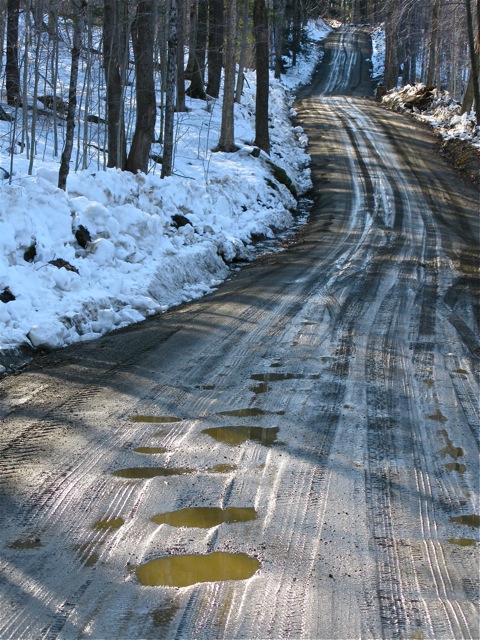
In Vermont there is a season called mud season. I bet it exists in other places too, but in Vermont it really gets the respect of being its own time, when the sap flows and the snow melts. Normally it is in March. The dirt roads get really hard to drive on, you slip and slide out of pot holes. You try to stay in the less deep ones but fall back into those most used ones. You get stuck sometimes.

This came to mind as I was thinking of the pathways of the mind, which are habits really, the way we let ourselves be led down familiar paths of belief and consternation. The mind does not like change, though apparently it is always capable of it, you just need to keep reading, keep moving, making new connections between neurons, giving birth to new ideas. The Vermont road in spring is an apt metaphor for the striving, shedding, growing mind.

Remember the old pathways of the mind:
Roads, I wish they hadn't been mine,
well-rutted, pitted, full of mud,
I trode them to dark places,
when you were mine, I practiced thinking you weren't.

Those roads, I see them now grown over
with weeds, and I remember their appeal.
Did I feel brave? I liked the danger I suppose,
or maybe had too much time, was lazy;
I did not take my own hand to lead myself away.

Now I can. I won't take that road today.
But you aren't here to lead me astray,
the mind says, won't take the blame
for twisting fate to castigate your name.
I'm tired and I remember the gifts.

What if? All the love I wanted to give you,
did I drag it down that lane? Did I leave it there,
to rot, hot in the sun? I wish there was a path not yet begun
for us to wander, find in shade a glade in which to love. 

I wrote this poem today in an emotional spurt inspired by an exchange of words. It is an emotional day, where one feeling is passing like another in the sky. Another apt metaphor for the ever-changing mind. I cried reading about mud season in Vermont because I miss the beauty that is there. I laughed because I didn't like the style of what I was reading. I was angry, I stopped, I reread again. I liked it or I didn't like it, I judged it, I accepted it. I watched all this go by. Observation, perhaps that is wherein new pathways lie.  

Thursday, March 6, 2014

What Power Art Thou

When the spring energy comes and the birds start to sing in the early morning, before the spring is really here, I wake up at 5, 6 o'clock in the morning. Sometimes I try to get back to sleep, but I usually can't. Lots to write, or read, or think about. Everything is active in my mind. Dream residue. First lines of other people's poems come: The force that through the green fuse drives the flower. My heart is alive too, in a gentler way. It asks the questions, sometimes shows me the way.

I like to be alive in the morning. One can't help but ask what is this power, this force that comes back again.

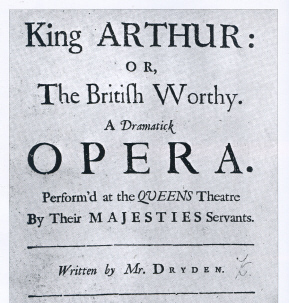
I think of the Purcell opera King Arthur and Dryden's words, the mountain waking up to love.
It is also called The Cold Song. Klaus Nomi sang it.

What power art thou, who from below
Hast made me rise unwillingly and slow
From beds of everlasting snow
See’st thou not, how stiff, how stiff, and wondrous old
Far unfit to bear the bitter cold,
I can scarcely move or draw my breath,
can scarcely move or draw my breath
Let me, let me freeze again to death.

Purcell died of TB at the age of 36. That's how old I'll be soon. Dryden lived to be 68.

I wrote this poem in response to those lines at this time of year last year. I wanted to hear Cupid, the new life of spring, and what he would say to the Cold Genius. I was thinking of a mountain I wanted to wake up.

What Power Art Thou

Here I am again, Cupid.
You're the mountain who won't wake up,
Genius. You're clever
or at least you think so.
No, you're asleep, and humble.

I'm silencing my mind,
trying to be more like you
but still I want you to wake up.

It's raining now, not snowing, you don't want to freeze.
You want to come to all this joy.
Though it's juvenile and you're not, it isn't below you.
Sure, you're tall, like a mountain, so you're used to looking down,

but don't. There must be some way
we could see eye to eye. Your heart
could then melt, you could wake up,
catch me, all wings and flutter, young and warm and
I'd accept the slow movement of your thawing limbs.

Tuesday, February 18, 2014

Philologia

I have to finish the section of my dissertation on the history of philology, this week or the next, and I've been writing it for about three years. When I began this blog actually, I was writing about, reading about, dreaming about Philology, the maiden in the De Nuptiis Philologiae et Mercurii.  

I think I wrote this poem last year, almost complete. I was wishing I was more like Philology I think, seeing her as a model for myself.

Philologia

The days are longer and
I sit in bed and read and dream
about Philology who
finally found her mate.

She was younger than me,
a virgin and she didn't have
experience, but she valued the word
and her knowledge was great.

Philosophy played to the dinner plate.
Harmony composed lines
more beautiful than
anyone could understand.

Hail the new dawn!

A marriage to the letter
is all I ever wanted and
the body of the book is
kinder than that of man.
 
I stopped and prayed.
I didn't think. I tried to find
the beginning of this questioning
which always was, which never began.

I'll take it home tonight
and meet it there.
I'll take it to bed.
We'll stay there.

I've had trouble, well, trouble, it's taken me a long time to finish this part of my dissertation because I couldn't really figure out why I was writing it. I mean, I knew I had to write it, that it was a part of my work, but I couldn't articulate why. Now I think I know. Those men, philologists, I'm trained by, I come after, they had all the science of the letter right, but they had lost the love. They had the logos of philology but they had lost the philia, which comes first, really. Or they had lost, in any case, their connection to it, their ability to let it help them create meaning. I saw that in earlier representations of philology, love was still there (Philology was a maiden, a princess, a wife, a mistress) and somewhere along the line, we stopped understanding medieval texts because we stopped loving learning as they did. So that's my argument really. I think I can finish it now that I know. I'm not entirely sure what the implications are if a female personification of philology helps us love writing and reading more, and understand old texts better, but I think it does. It helps me understand myself actually, and be more loving towards my own striving, as well as to my own resistance to learning. The very laziness of my grasping brain.

Saturday, February 1, 2014

Rapunzel

A while ago, I was thinking of Rapunzel and then wanted to write a poem about her which would capture the essential elements of the story without really telling it. What makes it a narrative? What makes it itself? And what does it mean?

I didn't post it then, but now here it is, the draft not a draft in fact. I found it in the internet space of this blog almost completed. I only had to add the subtitle (it said Rapunzel or) and change some words.

Rapunzel
or
How ears let eyes and hair grow back again

At first there was a couple
with just one little window
to look through, then she saw
a salad, wanted it, green, sweet.

The man climbed down the wall,
to satisfy the wife, got caught by
the angry witch. They lost their child.
We never hear of them again.

The child grew and grew,
lived in a tower, her hair
grew long, she let it down,
the witch climbed.

Who did she talk to?
She sang. A man came,
heard, his eyes, he'd lose,
couldn't see her, wanted to.

He finds the way in.
She's scared. She says
I don't know how
to get down.

He brings her
strands of silk
to make a ladder. 
They make twins.

Rapunzel tells the witch
she is heavy, heavier than
her prince. She knows
she rages, scissors.

Rapunzel loses her hair.
Golden braids hang,
trick the prince,
she's lost in a desert.

He's blind, his eyes pierced,
though it was his ears
that first drew him, now
he wanders, till

he comes to the desert.
He hears a voice again,
It's hers, she sees him,
she cries on his eyes, they heal.

Healed, they love,
their twins, united,
tongues, mouths sing,
ears, eyes, the braids

presumably grow back.
No longer in need of a ladder
they tie them around their waists
like yellow silk. 

Reading this poem which has been sitting here so long it is no longer mine, I note that it is about recognition, and what to trust. There is the green salad, outside, the witch who climbs, these things that bring us out of ourselves, threaten us. Then there is the inside space of the tower, the song sung to oneself which attracts the lover. The lover who recognizes because he loves. These are, for the Jungian reader, ways to read the story as a portrait of the psyche (after Clarissa Pinkola Estes in Women who Run with Wolves, my Bible for a while). Ultimately, the soul makes itself whole again (the twins reunited!)  through the different steps in the story, from blindness and separateness to togetherness and light. The story can also teach us out to be available to ourselves (though I cut off my hair in grief, it grows back, I braid it and wrap it around myself).

And this is exactly what I've been learning this past week at a singing workshop on the northern tip of Scotland.

Sight is perhaps the least dependable of senses, when it comes to love.  The ears, in the end, are more dependable, and win out. The witch does not know to pierce them.

So, Rapunzel is perhaps an ode to singing.

Thanks to all the brave singers on that sometimes scary road with me last week!

Thursday, March 14, 2013

Constellations

We saw figures in the sky.
How the little dipper
poured into the big dipper
but the dragon came between.

Cassiopeia, small W
stared at Andromeda while
Perseus chased Taurus who
cried out to Gemini.

Then there is that
other part of the sky,
the part I haven't seen yet
you were born under

Orion's belt,
Monoceros,
the one horned,
Lepus, Pictor,

Reticulum,
Hydrus, Volans,
Chameleon,
Pegasus was bigger.

You changed sides,
Phoenix, dying in your ashes
rising again, on the other side
of the sky.

Wednesday, October 10, 2012

Rainbows

I think 
you know
our parallel
realities;

not of our time
or in our time,
these days
we don't take time
to notice the rest.
It's all grey;
the color here
is ours.

It stretches out,
two arches lined,
the double rainbow
of our hearts.

Wednesday, September 26, 2012

Honeysuckle in the Well

Honeysuckle
There was honeysuckle in the well,
a promise.

A thyme bush
that didn't die
or all the things
I didn't tell you yet.

When I stop wanting
what I don't want
I swear,
I'll call you.

When our dreams
align or the
cedar strives or
the morning glory vine
opens on a day
brand new
I thought was old,
I'll tell you.

It isn't time yet.

There was honeysuckle in the well,
a promise.

Monday, September 17, 2012

Late Summer Flies

Late summer flies
too many goodbyes
leave me hard up
and breathless yet breathing.
I'm cleaning.

There're spots on the walls
not enough calls
and an absence,
a longing,
retreating.

Maybe I'll start
making rhymes with no heart
that are empty
and don't stop
repeating.

Maybe I'll call
this beginning of fall
and rolled up in a ball,
I'll keep bleating and slowly
receding.

I don't usually start a post with a poem, but today I wanted to. Because I wrote it yesterday while I was cleaning my kitchen and it expresses my current frustration better than any witty introduction might.

So I know there are cycles in life, and that this is the end and the beginning of one for me, and that I just have let things go and flow and wait for the new, but this is hard to do when all I want to say is: this cycle sucks.

And don't you dare ask me about my dissertation.

And modesty is overrated. I've been thinking about confidence, and how I need it, in order to do the things I want to do, to have the things I need, and how I just don't have it now, which is probably why I can't get any work done. This cycle sucks.

I actually feel like I can't do anything, and this poetry blog becomes just another rant, which is not what I want it to be. I have been writing a lot of poems, what with all the feelings I've been feeling and letting flow, or rather leak, so that is one thing. But I'm not sure these kinds of poems, these, my-chest-is-about-to-burst-and-snot-is-everywhere poems, these "I can't stand it anymore and words are no good but I've got to get something out and down or else I'll drown" poems are the best kind.

Here is something a friend posted the other day on our favorite social network website:

"We talk much too much. We should talk less and draw more. I personally should like to renounce speech altogether and, like organic Nature, communicate everything I have to say in sketches. That fig tree, this little snake, the cocoon on my window sill quietly awaiting its future - all these are momentous signatures. A person able to decipher their meaning properly would soon be able to dispense with the written or spoken word altogether. The more I think of it, there is something futile, mediocre, even foppish about speech. By contrast, how the gravity of Nature and her silence startle you, when you stand face to face with her, undistracted, before a barren ridge or in the desolation of the ancient hills." Goethe

So maybe my poems are like sketches and that is a step in the right direction, but decidedly, I wish I was more like "organic Nature". I wish I talked less, that there was less noise around me, inside me. So, I'm working on peace of mind and simplicity and silencing my head. Ah, yes, that is what I can focus on, instead of the numerous rants of my multiple personalities. I wish I were always in touch the world's "momentous signatures". For now, I feel trapped and obsessed with these small things, these late summer flies.

I do want to say I am very grateful for friends. I know I am not alone as I go around and drone, towards the eventual end of this cycle that sucks.