Stories and poems

"The metaphoric image of 'orphan lines' is a contrivance of the detached onlooker to whom the verbal art of continuous correspondences remains aesthetically alien. Orphan lines in poetry of pervasive parallels are a contradiction in terms, since whatever the status of a line, all its structure and functions are indissolubly interlaced with the near and distant verbal environment, and the task of linguistic analysis is to disclose the levels of this coaction. When seen from the inside of the parallelistic system, the supposed orphanhood, like any other componential status, turns into a network of multifarious compelling affinities.'
Roman JAKOBSON, "Grammatical Parallelism and its Russian Facet", Language, 42/2, 1966, pp. 399-429, p. 428-429

Showing posts with label Philology. Show all posts

Saturday, February 21, 2015

A Tribute to the God of Thought

A Tribute to the God of Thought

Please, look at both sides of things.
Do not fear your own inhibitions.

Take out your mind one more time
and dissect it, the ripples are there for a reason.

Don't balk at your own contradictions.
Don't strive for a dead unity that isn't one,
similarity that is not fecund,
the grey matter of impossibility.

Let your process grow beyond recognition.
It will find a way.

Take it upon yourself to keep growing,
despite this dead way,
make a tribute to the God of thought.


I wrote this poem the day I left Geneva in January for travels up north. I am back now, and the the new lunar year has begun, and I need to get back to work. I'm wanting and expecting things to be different. A change will come. 

I'm unsure of where this poem came from. Maybe I just needed a break in thinking. Maybe I was tired of the God of thought.

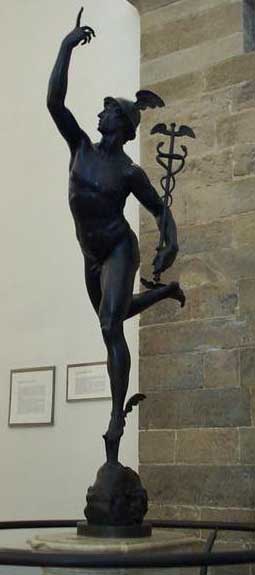
Who is the God of thought? My first thought was that it was Mercury, or Hermes, and it is. The internet first points me to Odin, who has two black crows who tell him things (two black crows tell me things too these days - I'm not sure what). Then someone in a comment on a strange page (one wonders where they all came from) said it was Hades, and thanked me for reading him, but I'm not sure about that, though it is in my poem, the dead way. Then there is Thoth, Egyptian God I don't know very much about but who surely is at the root of things, the root of thought. According to this website, he was the God of the moon. A scribe, he invented writing.

In any case, the God of thought is good at duality. Which makes me think, there is no good reason to think. We are better off without thinking, or, joy is a function of thoughtlessness, though reading messages from the world is a full time job. And Mercury married, guess who, Philology, and that brings me back to the reading and writing I have to get back to.


Thursday, December 18, 2014

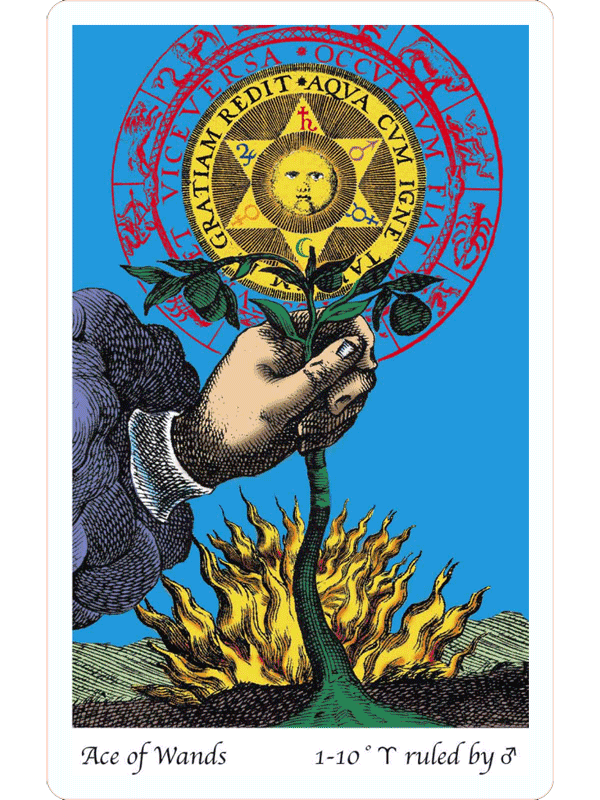
Ace of Wands

Oh yeah, I write poems. I haven't in a long time, or I do and then I put them away and I don't think about them. But today a tarot card inspired me and this came out and I shared it with a friend and then I thought, it wants to go out wider, so I'll send it on its way.

I'm back again with Philology, describing the 12th century Quedlinburg tapestry. This somehow takes a long time. Maybe because I haven't seen it in a long time, maybe because it is hard to understand how to understand these figures from another time. Still, I love them. You can look at them. 

I'm about seven pages from really finishing this chapter I've been writing for so long, but I feel stuck and haven't made much progress for a few days. I have been correcting too, and this makes every word feel weighty, as though you don't want to let it get away and it must be just right and it can't be.

Anyways, I got the reversed ace of wands, thinking about a situation I am unsure about. I really like my favorite deck's image, Golden Tarot, an angel with a flower and a wand, and a book at her knees, and the fire behind.

I looked at this one when I wrote the poem, from the Holy Light deck, but the other one was there too, in my mind, since I've looked at it so much :

There is the flame and the branches and the leaves, a good message for the winter solstice.

Ace of Wands

I’m stretching myself up,  
I’m getting taller,
I’m alone, but I have branches
leaves, I’m fueling energy
for growth, I like the way
I feel, I want to continue
this journey, I want to heal.

Reversed, I’m not reaching out,
I’m looking in. Inside
is the answer I am looking for,
though I doubt myself sometimes.
Though I am silent, I am not
ineffectual. I take action through
no action, I feed objectless desire.

There is a spark inside me that is ready
to burst into flames. Watch out or else
you might get burned. It’s all new and
waiting. This fury will become
something good, with time, this rod,
stick, wand, will grow in two directions,
both up and down, so hold on.  

May all of your darkest nights be bright!

Wednesday, September 14, 2011

Meaning

The Meaning of Night
I'm looking for jobs. I'm still looking for meaning. I'm reading another book by H. U. Gumbrecht called Production of presence: What meaning cannot convey and I'm wondering how he hopes to go beyond meaning. But I probably should get back to practical things, like money, like work; maybe that is what he means by the production of presence. Or maybe I should get back to meaning.

Still wrestling with my chapter on the De Nuptiis, I'm reading the Metalogicon by John of Salisbury. Here is a wonderful thing he has to say about meaning:

Le sens en effet est la signification du mot. Et s'ils lui font défaut, une parole est vide et inutile et pour ainsi dire morte, de sorte que, d'une certaine façon, de même que le corps reçoit sa vie de l'âme, la signification du mot lui sert à vivre (p. 170).

This is the French translation by F. Lejeune, published in 2009, and luckily so for me since I would have been slower to integrate the Latin. The translation also solves the problem of quoting him in French in my dissertation. Thanks to en excellent index, I have also quickly been able to find out who Philologia was for John of Salisbury. Here is my English translation of the passage from the French.

"Meaning is indeed the signification of a word, without which the word is dead, since, in a way, like a body which depends on the soul for life, the signification of a word allows it to live."

Another English translation gives:

"A word's force consists in its meaning. Without the latter it is empty, useless and (so to speak) dead. Just as the soul animates the body, so, in a way, meaning breathes life into a word".

This is Daniel McGarry's translation, p.81. Here is the Latin

vis enim verbi, sensum est; quod si destituatur, sermo cassus et inutilis est, et, ut sic dixerim, mortuus: ut quodammodo, sicut corpus ad vitam vegetatur ab anima, sic ad vitam quamdam verbi sensus proficiat.

The word vis gives force in English and signification in French, which comes from the Anglo-Norman  significaciun, according to the O.E.D. Sensum gives meaning in English and the French sens, which feels more natural since it is closer to the Latin. I'm not sure where all this is going, but, in any case, these different translations show the circular nature of signifying : word, meaning, meaning, word. I think John is right; you can't seperate word from meaning without a kind of death.

So what's the point of Gumbrecht's book? I think he is tired of meaning, all sorts, and wants to imagine an entirely other type of intellectual activity that could rise above hermeneutics. But couldn't this be the soul-death of the discipline? Where would we be without meaning? He uses Heidegger's essay "The Origin of the Work of Art," an essay which I once found terribly problematic in terms of how it represents work and how it represents art, as well as his concept of Dasein, being in the world, not interpreting it or being a subject in it. Still, I like Gumbrecht's book, though I haven't finished it yet. I like his attempt to surpass meaning, sort of like a meditative mind clearing, a move to having no head and non-being (his last chapter is entitled To Be Quiet for a Moment: About Redemption). Maybe it is about embracing that death.

I'm having trouble picking a poem today. I have lots of poems which contain the word meaning. I think I'll put one I wrote while mourning the death of meaning, blaming it on men, of course. 

Last War

These men would destroy meaning with
a force equal to the bomb.
Love turned to contract,
its attributes of folly 
which are feeling.

A world without meaning
or feeling like a funeral shroud,
a winding sheet of white
which death announced and called for
as necessity.

These men would destroy meaning.
No poetry, no thought
tapped in movements between bodies,
no sentient wisdom,
no harking to the present call.

Burning the witches of remorse,
leaving us simmering over pots
and singing 
in fires clamped down,
now cold.

These men would destroy meaning,
gather verse to sticky prose
and bind the two together,
frigid
fixed.

These men would destroy meaning.
Let me gather in my breast
the contrast and the opposition,
the pregnancy of thought,
give birth to new before the end is brought.

Sometimes I get tired of reading the work of male intellectuals and philosophers, though I suppose I can't blame John of Salisbury and I try not to be overly aware of the gender of the author while reading. It sort of gets in the way, of the meaning. 

Tuesday, August 16, 2011

Berlin Notes

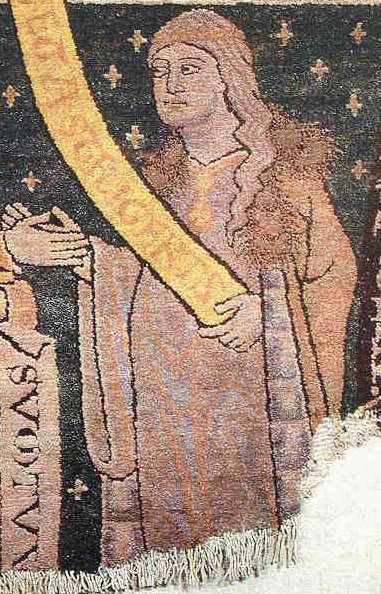
I'm leaving tonight, on the train, to go back to Geneva. The week went by quickly. We went to Quedlinburg so that I could look at a 12th century tapestry, now in fragments, representing the Marriage of Philology and Mercury. 
Here we see Piety and Justice embracing.

The Church this tapestry was housed in was an SS meeting hall for Nazi ceremonies during the war.

War as Timeless

In early pictures
Hitler wore shorts,
leiderhosen, sat with dogs,
a friend to babies.

These are the politicians
that make the decisions
that leave holes in faces
as well as places.

Shattered minds now
as when in ancient times,
altars destroyed, spears thrown,
the god of war cried out and made himself be sculpted.

I wonder what the Nazis thought of the tapestry, or of philology. Wagner was a great friend of Nietzsche, and philology was often used for nationalistic purposes. The origins of languages and the fascist cause, bosom buddies, and the dangers of wanting to own history, dictate the future. 

I think she looks lovely, holding hands with Mercury. He says, I am yours, in a ribbon unrolling across his body. I am still deciphering her words. The tapestry was apparently commissioned by an abbess named Agnes, for the Pope. I am glad she didn't have to live to see the 20th century.  

A visit to the Pergamon

Eros has wings and serpent legs,
and he is doing things to men.

With one bent foot under his squatting body,
his buttocks, muscles and folds of skin
betray the tension of battle, captured on the wall.

In the center of the hall gathers all the youth of Germany,
who spotted, braced and badly dressed, stare at each other,
as altars to new gods, at the Pergamon Museum.

Thursday, July 28, 2011

The Marriage of Philology and Mercury

I've been thinking about how writing often takes you in unexpected directions, and about the need to theorize a new kind of research skill, the one I most often use, based on intuition. Often my best ideas or most useful references come when I am browsing in the library or looking for some other book. Dreams are also a great source of ideas, or the ones that come to me in the bathtub or during a shower, true insights from the blank whiteness of ceramic and tile.

Since it was born in such a way, I have been thinking about the section of my dissertation that I am writing now as a kind of unexpected growth, like a new limb that has slowly emerged out of the original body of what I had planned to write. It is a somewhat strange formation, but I like it. It definitely belongs there. It's a history of philology through her personifications through the ages. She has become very real to me, especially because of the De Nuptiis Philologiae et Mercurii, a strange and marvelous work by the fifth century African writer Martianus Capella. I fell asleep while reading it the other day and dreamed of figures who turned around me, like planets in the sky, but with hair and faces, in long robes.

Philologia

Yes, read the books I'm reading.
Strange tales of gods and stars,
turning cloudy planets like eyes,
yours, you'll see for yourself,
you'll like it. 

What's that name it mentioned?
A lost word, untracked and marked.
If you can find some meaning,
I can. Read it with me,
you'll like it.

The world is round, the universe an egg,
layers of air, imagined to cross;
we'll go there on clouds
led by horses with names like
Prudence, Destiny.

Hear it out, don't judge.
We'll go there together, you'll see.
We'll watch the gods sacrifice a goat, 
a sheep, a cow, all for the sake of
that slender girl.

I'm not sure who the "you" is in this poem, specifically. Often it is just there, in an open way. Feel free to feel included. In the meantime, I think I'm in love with the love of words.