Stories and poems

"The metaphoric image of 'orphan lines' is a contrivance of the detached onlooker to whom the verbal art of continuous correspondences remains aesthetically alien. Orphan lines in poetry of pervasive parallels are a contradiction in terms, since whatever the status of a line, all its structure and functions are indissolubly interlaced with the near and distant verbal environment, and the task of linguistic analysis is to disclose the levels of this coaction. When seen from the inside of the parallelistic system, the supposed orphanhood, like any other componential status, turns into a network of multifarious compelling affinities.'
Roman JAKOBSON, "Grammatical Parallelism and its Russian Facet", Language, 42/2, 1966, pp. 399-429, p. 428-429

Tuesday, February 18, 2014

Philologia

I have to finish the section of my dissertation on the history of philology, this week or the next, and I've been writing it for about three years. When I began this blog actually, I was writing about, reading about, dreaming about Philology, the maiden in the De Nuptiis Philologiae et Mercurii.  

I think I wrote this poem last year, almost complete. I was wishing I was more like Philology I think, seeing her as a model for myself.

Philologia

The days are longer and
I sit in bed and read and dream
about Philology who
finally found her mate.

She was younger than me,
a virgin and she didn't have
experience, but she valued the word
and her knowledge was great.

Philosophy played to the dinner plate.
Harmony composed lines
more beautiful than
anyone could understand.

Hail the new dawn!

A marriage to the letter
is all I ever wanted and
the body of the book is
kinder than that of man.
 
I stopped and prayed.
I didn't think. I tried to find
the beginning of this questioning
which always was, which never began.

I'll take it home tonight
and meet it there.
I'll take it to bed.
We'll stay there.

I've had trouble, well, trouble, it's taken me a long time to finish this part of my dissertation because I couldn't really figure out why I was writing it. I mean, I knew I had to write it, that it was a part of my work, but I couldn't articulate why. Now I think I know. Those men, philologists, I'm trained by, I come after, they had all the science of the letter right, but they had lost the love. They had the logos of philology but they had lost the philia, which comes first, really. Or they had lost, in any case, their connection to it, their ability to let it help them create meaning. I saw that in earlier representations of philology, love was still there (Philology was a maiden, a princess, a wife, a mistress) and somewhere along the line, we stopped understanding medieval texts because we stopped loving learning as they did. So that's my argument really. I think I can finish it now that I know. I'm not entirely sure what the implications are if a female personification of philology helps us love writing and reading more, and understand old texts better, but I think it does. It helps me understand myself actually, and be more loving towards my own striving, as well as to my own resistance to learning. The very laziness of my grasping brain.

Saturday, February 1, 2014

Rapunzel

A while ago, I was thinking of Rapunzel and then wanted to write a poem about her which would capture the essential elements of the story without really telling it. What makes it a narrative? What makes it itself? And what does it mean?

I didn't post it then, but now here it is, the draft not a draft in fact. I found it in the internet space of this blog almost completed. I only had to add the subtitle (it said Rapunzel or) and change some words.

Rapunzel
or
How ears let eyes and hair grow back again

At first there was a couple
with just one little window
to look through, then she saw
a salad, wanted it, green, sweet.

The man climbed down the wall,
to satisfy the wife, got caught by
the angry witch. They lost their child.
We never hear of them again.

The child grew and grew,
lived in a tower, her hair
grew long, she let it down,
the witch climbed.

Who did she talk to?
She sang. A man came,
heard, his eyes, he'd lose,
couldn't see her, wanted to.

He finds the way in.
She's scared. She says
I don't know how
to get down.

He brings her
strands of silk
to make a ladder. 
They make twins.

Rapunzel tells the witch
she is heavy, heavier than
her prince. She knows
she rages, scissors.

Rapunzel loses her hair.
Golden braids hang,
trick the prince,
she's lost in a desert.

He's blind, his eyes pierced,
though it was his ears
that first drew him, now
he wanders, till

he comes to the desert.
He hears a voice again,
It's hers, she sees him,
she cries on his eyes, they heal.

Healed, they love,
their twins, united,
tongues, mouths sing,
ears, eyes, the braids

presumably grow back.
No longer in need of a ladder
they tie them around their waists
like yellow silk. 

Reading this poem which has been sitting here so long it is no longer mine, I note that it is about recognition, and what to trust. There is the green salad, outside, the witch who climbs, these things that bring us out of ourselves, threaten us. Then there is the inside space of the tower, the song sung to oneself which attracts the lover. The lover who recognizes because he loves. These are, for the Jungian reader, ways to read the story as a portrait of the psyche (after Clarissa Pinkola Estes in Women who Run with Wolves, my Bible for a while). Ultimately, the soul makes itself whole again (the twins reunited!)  through the different steps in the story, from blindness and separateness to togetherness and light. The story can also teach us out to be available to ourselves (though I cut off my hair in grief, it grows back, I braid it and wrap it around myself).

And this is exactly what I've been learning this past week at a singing workshop on the northern tip of Scotland.

Sight is perhaps the least dependable of senses, when it comes to love.  The ears, in the end, are more dependable, and win out. The witch does not know to pierce them.

So, Rapunzel is perhaps an ode to singing.

Thanks to all the brave singers on that sometimes scary road with me last week!

Thursday, March 14, 2013

Constellations

We saw figures in the sky.
How the little dipper
poured into the big dipper
but the dragon came between.

Cassiopeia, small W
stared at Andromeda while
Perseus chased Taurus who
cried out to Gemini.

Then there is that
other part of the sky,
the part I haven't seen yet
you were born under

Orion's belt,
Monoceros,
the one horned,
Lepus, Pictor,

Reticulum,
Hydrus, Volans,
Chameleon,
Pegasus was bigger.

You changed sides,
Phoenix, dying in your ashes
rising again, on the other side
of the sky.

Wednesday, October 10, 2012

Rainbows

I think 
you know
our parallel
realities;

not of our time
or in our time,
these days
we don't take time
to notice the rest.
It's all grey;
the color here
is ours.

It stretches out,
two arches lined,
the double rainbow
of our hearts.

Wednesday, September 26, 2012

Honeysuckle in the Well

Honeysuckle
There was honeysuckle in the well,
a promise.

A thyme bush
that didn't die
or all the things
I didn't tell you yet.

When I stop wanting
what I don't want
I swear,
I'll call you.

When our dreams
align or the
cedar strives or
the morning glory vine
opens on a day
brand new
I thought was old,
I'll tell you.

It isn't time yet.

There was honeysuckle in the well,
a promise.

Monday, September 17, 2012

Late Summer Flies

Late summer flies
too many goodbyes
leave me hard up
and breathless yet breathing.
I'm cleaning.

There're spots on the walls
not enough calls
and an absence,
a longing,
retreating.

Maybe I'll start
making rhymes with no heart
that are empty
and don't stop
repeating.

Maybe I'll call
this beginning of fall
and rolled up in a ball,
I'll keep bleating and slowly
receding.

I don't usually start a post with a poem, but today I wanted to. Because I wrote it yesterday while I was cleaning my kitchen and it expresses my current frustration better than any witty introduction might.

So I know there are cycles in life, and that this is the end and the beginning of one for me, and that I just have let things go and flow and wait for the new, but this is hard to do when all I want to say is: this cycle sucks.

And don't you dare ask me about my dissertation.

And modesty is overrated. I've been thinking about confidence, and how I need it, in order to do the things I want to do, to have the things I need, and how I just don't have it now, which is probably why I can't get any work done. This cycle sucks.

I actually feel like I can't do anything, and this poetry blog becomes just another rant, which is not what I want it to be. I have been writing a lot of poems, what with all the feelings I've been feeling and letting flow, or rather leak, so that is one thing. But I'm not sure these kinds of poems, these, my-chest-is-about-to-burst-and-snot-is-everywhere poems, these "I can't stand it anymore and words are no good but I've got to get something out and down or else I'll drown" poems are the best kind.

Here is something a friend posted the other day on our favorite social network website:

"We talk much too much. We should talk less and draw more. I personally should like to renounce speech altogether and, like organic Nature, communicate everything I have to say in sketches. That fig tree, this little snake, the cocoon on my window sill quietly awaiting its future - all these are momentous signatures. A person able to decipher their meaning properly would soon be able to dispense with the written or spoken word altogether. The more I think of it, there is something futile, mediocre, even foppish about speech. By contrast, how the gravity of Nature and her silence startle you, when you stand face to face with her, undistracted, before a barren ridge or in the desolation of the ancient hills." Goethe

So maybe my poems are like sketches and that is a step in the right direction, but decidedly, I wish I was more like "organic Nature". I wish I talked less, that there was less noise around me, inside me. So, I'm working on peace of mind and simplicity and silencing my head. Ah, yes, that is what I can focus on, instead of the numerous rants of my multiple personalities. I wish I were always in touch the world's "momentous signatures". For now, I feel trapped and obsessed with these small things, these late summer flies.

I do want to say I am very grateful for friends. I know I am not alone as I go around and drone, towards the eventual end of this cycle that sucks.


Friday, August 3, 2012

Mistress Modesty

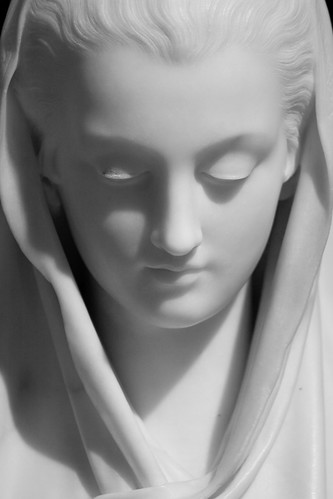
Modesty, by Giosue Argenti, circa 1866
I've been thinking lately about modesty, humility. It has been coming up a lot in my I Ching readings. In the I Ching, there are two hexagrams which deal with modesty. One is hexagram 15, earth over mountain, which is about how the low is raised high, and the other is 57, wind over wind, about the cumulated product of small, persistent actions. 

Modesty is also a part of hexagram 2, the receptive, earth over earth, and a fundamental virtue of the female energy, the yin, the receptive energy in the Chinese understanding of such things.
I'm a self-schooled I Ching reader, so it seems strange to talk about it here, but it keeps coming back to me as a message so I thought of sharing it. I even got it recently on my Yogi tea label, in German, "allow others to be better than you," or something like that.

So this is a real good summer for humility. I have not written as much as I wanted to. Humility. As the need for me to finish draws ever nearer, I feel less and less up to the job. Humility. I am in love with someone who does not want to be with me. Humility. But somehow, like the I Ching says, all this humility brings, and you may have guessed it, abundance.

Why does humility breed abundance? Because when something doesn't value itself too much, it can receive. Maybe that is why, financially, things are a bit easier at the moment.

But it mustn't be a false humility. And it isn't a passive modesty. Modesty is persistent, and doesn't stand back. So this idea of an active modesty is a bit tricky. But I like it. It is a bit like getting off one's high horse, looking around, breathing in, and doing what one thinks is right anyways, despite, even though, the winds seem to be moving against you.

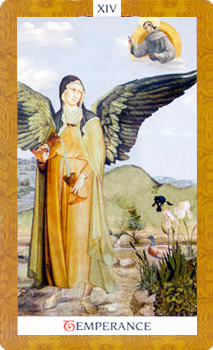
I link it to the Temperance card in the Tarot. I like Temperance. She reminds me to go slow, that I have wings, but that I can't always use them. She is carefully pouring water from one cup to another. All this takes time.


So a part of humility that I am learning is that things take time and that I can't rush things along with my own little human mind which wants to get things done or have things a certain way.
 

Why do I want things a certain way? Well, that brings me back to humility because the reason I want things a certain way is that I think I know best. But I don't.

So there can be a lot of humility learned in daring to take a look at one's self, honestly. Part of humility is being in touch with reality.

I'm glad though to be leaving all my humiliating realities behind next week when I go up to the mountains. Up there, I'll sing, and I'll feel really good about myself, but sort of out of myself too, so the feeling good won't go to my head. It will be great. It will be cool, and I'll just disconnect. But before I do, I'll find a poem I wrote for you about humility:

Wind writing poems

The wind is writing poems today, 
the wild and futile kind. 

I am writing poems today, 
the hopeful silent kind. 

Is the wind taking your soul away? 
Let it stay, let it stay, 
a little more, a little more. 

Is the light out in your breast? 
Let it rest, let it rest,
a little more, a little more. 

Do you struggle at the reins? 
Lay them calm, lay them calm. 

Let go and love is all the same,
lay them calm, lay them calm.  

Well, in all my typed poems, I didn't once find the word modesty or humility, not surprisingly. What do poems have to do with her? They're all about assertive yang energy, the being of a writer. Think of Byron and his many mistresses, or the desire to publish, be well-known. But I rather liked this one, and it seemed to fit; a timid poem, moving forward repetitively.